
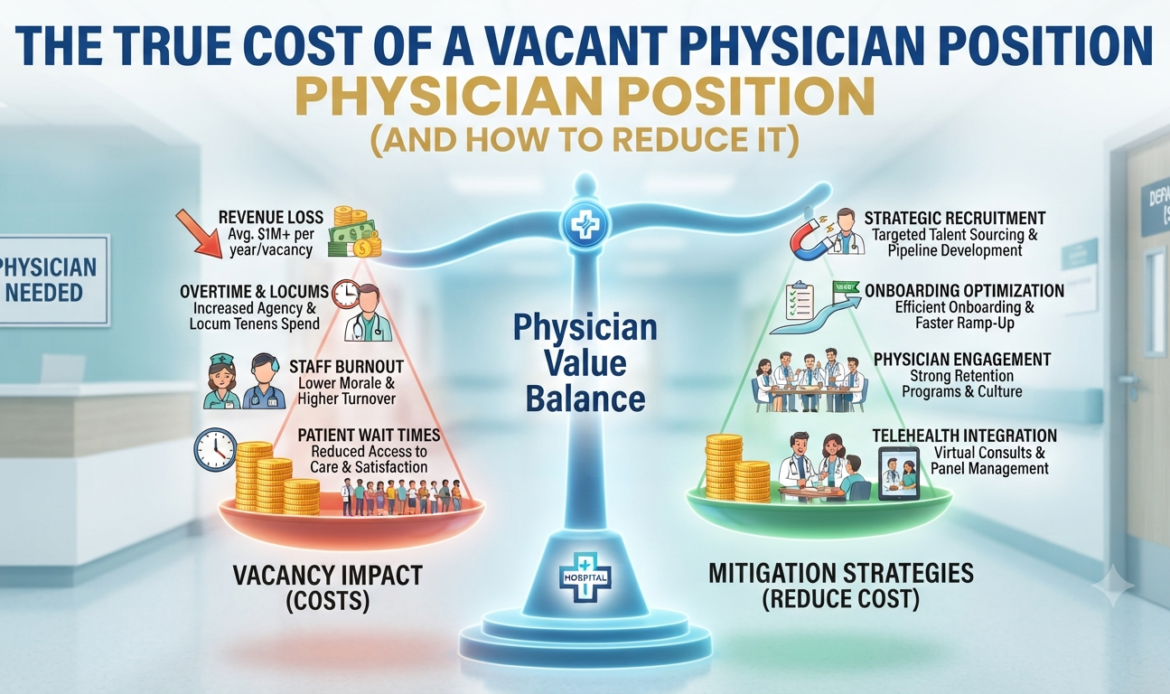
When a physician gives notice, most administrators immediately start calculating the obvious number: the salary being budgeted for the role. But that figure barely scratches the surface. The cost of a vacant physician position extends far beyond an unfilled line item — it shows up in lost billing, overtime pay, locum coverage, staff burnout, and patients who quietly leave for another provider. Understanding the full cost of a vacant physician position is the first step toward justifying faster, better-resourced recruitment.
This guide breaks down where that cost actually comes from, how it compounds the longer a role stays open, and what healthcare organizations can do to shorten time-to-fill and protect revenue.
Why the Cost of a Vacant Physician Position Is Higher Than It Looks
A physician generates revenue well beyond their base salary — through patient visits, procedures, referrals to specialists and ancillary services, and the downstream care their patients need across the health system. When that physician’s seat sits empty, none of that revenue is captured, even though most of the practice’s fixed costs (rent, staff salaries, equipment, administrative overhead) continue as usual.
This is why healthcare finance teams increasingly track the cost of a vacant physician position as a distinct budget metric rather than folding it into general recruitment spend. It reflects real, measurable revenue loss, not just a hiring inconvenience.
The Direct Costs
Lost Clinical Revenue
The most immediate impact is lost billing. Each week a physician role sits open, the appointments that provider would have filled — new patients, follow-ups, procedures — either move to other providers who are already at capacity, get pushed out weeks or months, or are lost entirely to competing practices. In primary care and high-volume specialties, this lost revenue accumulates quickly.
Locum Tenens and Coverage Costs
Many organizations bridge the gap with locum tenens providers to maintain patient access. While necessary, locum coverage is typically priced at a significant premium over a permanent salary once agency fees, housing, and travel costs are included. Extended reliance on locum coverage can end up costing more over a year than the position itself would have paid.
Recruitment and Onboarding Spend
Advertising, agency fees, credentialing costs, and the administrative time spent screening and interviewing candidates all add to the running total — and these costs are incurred again for every search that has to be restarted due to a bad hire or a candidate who accepts another offer mid-process.
Sign-On Bonuses and Relocation Incentives
To compete for scarce candidates, many organizations offer sign-on bonuses, relocation packages, or student loan assistance. These incentives are a legitimate part of a competitive offer, but they also represent an additional cost layer that should be factored into any full accounting of the cost of a vacant physician position, particularly in rural or hard-to-staff markets where incentives tend to be larger.
How Different Specialties Compare
The financial impact of a vacancy is not uniform across specialties. High-revenue-generating specialties, such as surgical subspecialties, tend to carry a steeper cost of a vacant physician position because of the procedural and downstream referral revenue lost during the vacancy. Primary care vacancies, while often lower in per-visit revenue, can carry outsized indirect costs because primary care physicians drive a large volume of referrals to specialists, imaging, and ancillary services across a health system. Practices should weigh both direct billing loss and downstream referral impact when prioritizing which open roles to fill first.
The Indirect Costs (Often the Larger Problem)
Overtime and Burnout Among Remaining Staff
When a physician position goes unfilled, the patient load doesn’t disappear — it gets redistributed to the remaining team. Colleagues absorb extra patients, extended hours, and additional call coverage. Over time, this contributes directly to the burnout and turnover cycle covered in our article on reducing healthcare turnover, which can turn one vacancy into two or three.
Patient Attrition
Patients who cannot get timely appointments often do not wait — they find another provider. Some of that attrition is permanent, even after the position is filled, because building new patient relationships takes time. This is one of the least visible but most damaging components of the cost of a vacant physician position, since lost patients rarely show up as a clean line item on a budget report.
Reputational and Referral Impact
Referring physicians and community partners notice when a practice consistently struggles to see new patients. Over time, this can quietly reduce referral volume, compounding the revenue impact well beyond the vacancy period itself.
Online reviews compound this effect. Patients frustrated by long wait times or being unable to book with a preferred provider often leave negative feedback that outlasts the vacancy itself, influencing prospective patients long after the role has been filled. Rebuilding a damaged online reputation typically takes far longer than the vacancy that caused it, which is another reason vacancy cost should be measured over a longer time horizon than the search period alone.
How Time-to-Fill Compounds the Cost
The cost of a vacant physician position is not linear — it accelerates the longer a role stays open. A vacancy filled in 30 days causes meaningfully less damage than one that drags on for 90 or 120 days, for a few reasons:
- Locum coverage costs compound weekly, and many organizations start with short-term coverage that becomes progressively more expensive as the search extends.
- Staff burnout deepens the longer colleagues cover extra patient load, increasing the risk of additional departures.
- Patient attrition accelerates once patients start experiencing repeated scheduling friction rather than a single delay.
- Candidate quality often declines in extended searches, as organizations feel pressure to accept a weaker match just to close the gap.
This is why time-to-fill, not just search cost, should be treated as a primary lever for controlling the overall cost of a vacant physician position.
A Simple Framework for Estimating Your Own Vacancy Cost
While every organization’s numbers differ, a useful starting framework includes:
- Weekly lost clinical revenue (average weekly billing generated by the role)
- Weekly locum or coverage premium (locum rate minus what the permanent salary would have cost on a weekly basis)
- Overtime and coverage costs paid to existing staff to absorb the gap
- Estimated recruitment costs (advertising, agency fees, credentialing, internal staff time)
Multiplying the weekly figures by the actual number of weeks the position remains open quickly illustrates why even a modest reduction in time-to-fill has a measurable financial impact.
Vacancy Cost Drivers at a Glance
| Cost Category | Example Drivers | Compounds With Time? |
|---|---|---|
| Direct revenue loss | Unbilled visits, procedures, referrals | Yes |
| Coverage costs | Locum fees, overtime, travel/housing | Yes |
| Recruitment spend | Advertising, agency fees, credentialing | Somewhat |
| Staff burnout | Extra call, extended hours, low morale | Yes |
| Patient attrition | Scheduling friction, competitor switching | Yes, and often permanent |
| Referral erosion | Reduced trust from referring providers | Yes, slow to reverse |
Reviewing vacancy cost through this lens helps leadership teams see why a role that looks manageable on paper in week one can become a significant financial and operational problem by week twelve.
How to Reduce the Cost of a Vacant Physician Position
Start the Search Before the Vacancy Opens
Organizations that begin sourcing candidates as soon as a departure is anticipated — rather than after the position is officially open — consistently shorten total vacancy time. A continuous recruitment pipeline, rather than a reactive one, is one of the most effective ways to reduce the cost of a vacant physician position over time.
Pre-Screen for Licensure and Credentialing Early
Credentialing delays are one of the most common reasons a strong candidate takes months to start instead of weeks. Verifying license status, board certification, and background checks earlier in the process prevents last-minute delays once an offer is accepted. Many organizations lose weeks not because a candidate is unqualified, but because primary source verification, malpractice history checks, and payer enrollment were not initiated until after the offer letter was signed. Building these steps into the earliest stages of the search, rather than treating them as a final formality, keeps a signed candidate from sitting in limbo while paperwork clears.
Move Quickly Once a Qualified Candidate Is Identified
In competitive specialties, strong candidates often have multiple active conversations. Facilities with slow interview and offer processes lose candidates to organizations that can extend a competitive offer within days rather than weeks.
Work With a Recruiter Who Guarantees Delivery Timelines
A specialized healthcare recruiting partner that pre-vets licensure, credentials, and cultural fit before presenting candidates can materially cut the sourcing phase of a search. Our guide on physician recruitment best practices covers how a structured, expertise-driven process shortens time-to-fill without sacrificing candidate quality.
Build in a Replacement Guarantee
Even a strong hire carries some risk of an early departure. A written replacement guarantee — where a recruiting partner replaces a candidate who leaves within a defined window at no additional cost — protects the organization from having to absorb the full cost of a vacant physician position twice for the same role.
Taken together, these factors show why vacancy cost should be reviewed as an ongoing operational metric rather than a one-time budgeting exercise. Facilities that track it consistently are better equipped to make the case internally for faster hiring processes and stronger recruiting partnerships.
Frequently Asked Questions
What is the average cost of a vacant physician position? Estimates vary widely by specialty, but most healthcare finance analyses show that lost revenue, locum coverage, and recruitment costs combined typically exceed the physician’s annual base salary when a position remains open for several months. The exact figure depends on specialty, patient panel size, and local market conditions.
How long does it typically take to fill a physician vacancy? Time-to-fill varies significantly by specialty and geography, with primary care and rural roles often taking longer than average due to smaller candidate pools. A structured, proactive recruitment process can meaningfully shorten this window compared to a reactive search, particularly when credentialing and interview steps are handled in parallel rather than sequentially.
Is locum tenens coverage cheaper than a permanent hire? Locum coverage is useful for bridging short-term gaps, but it is generally more expensive than a permanent salary once agency fees and travel or housing costs are factored in. It is best used as a temporary bridge, not a long-term solution.
Does the cost of a vacant physician position affect patient retention? Yes. Patients who experience long wait times or scheduling friction often seek care elsewhere, and some of that attrition persists even after the position is filled.
What is the fastest way to reduce vacancy-related costs? Starting recruitment proactively, pre-screening credentials early, and working with a specialized healthcare recruiter with a fast delivery guarantee are the most effective levers for reducing both the length and the cost of a vacancy.
Should sign-on bonuses be counted as part of vacancy cost? Yes. While sign-on bonuses and relocation incentives are offer-side investments rather than losses, they are a direct cost of filling a hard-to-staff role and should be included in any full financial picture of a search, especially in competitive or rural markets.
Stop the Bleeding From an Open Seat
Every week a physician role stays open, the cost of a vacant physician position keeps climbing — in lost revenue, staff burnout, and patients who don’t come back. Diamond Medical Recruiting operates on a pay-only-when-you-hire model, guarantees your first qualified candidate within 5-10 business days, and backs every placement with a 90-day replacement guarantee. If an open position is costing your organization more than the salary line suggests, contact our team or visit our employer page to start closing the gap.