
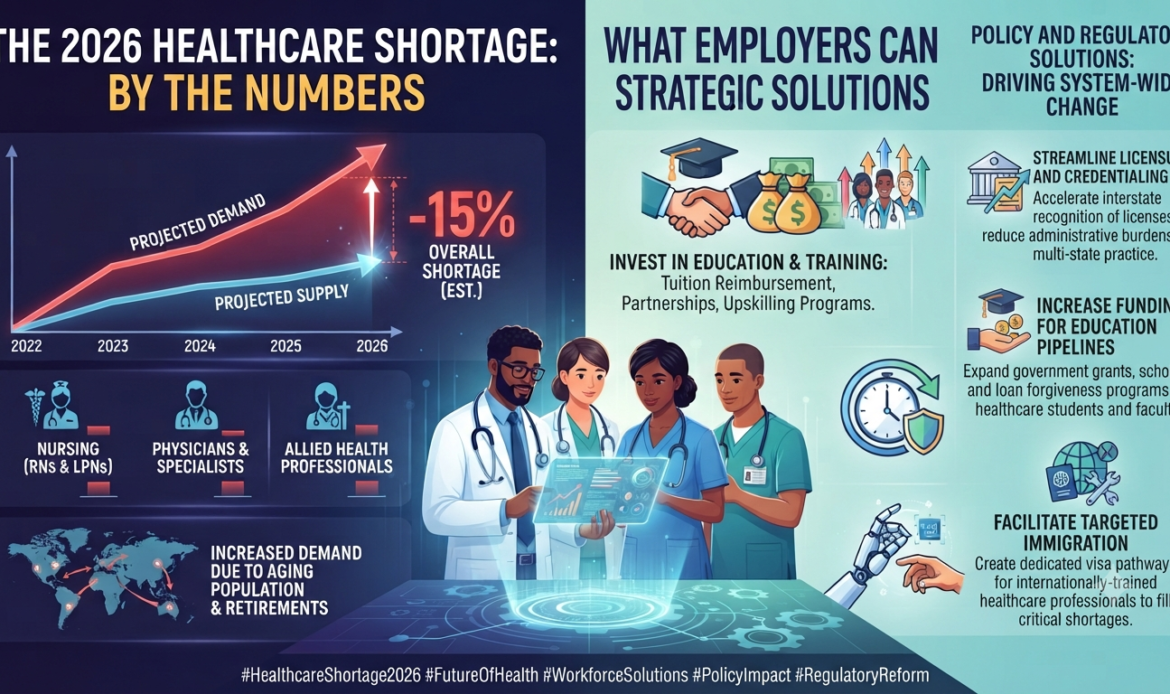
Every open position on a medical staffing schedule represents more than an administrative headache. It represents patients waiting longer for appointments, existing staff absorbing extra shifts, and revenue that never gets billed. Across the United States, this scenario is playing out at scale. The healthcare workforce shortage is no longer a future risk that facilities can plan around — it is the operating reality for hospitals, clinics, and urgent care centers today.
This article breaks down what the current data actually shows about the healthcare workforce shortage, why it is happening, which regions and specialties are hit hardest, and what practical steps healthcare organizations can take to keep roles filled despite a shrinking talent pool.
What Is the Healthcare Workforce Shortage?
The healthcare workforce shortage refers to the growing gap between the number of physicians, nurses, and allied health professionals the U.S. healthcare system needs and the number who are actively practicing or entering the field. It affects nearly every care setting — primary care practices, specialty clinics, hospitals, urgent care centers, and long-term care facilities — and it is projected to worsen over the next decade.
Unlike a temporary staffing dip caused by seasonal turnover, the healthcare workforce shortage is structural. It is driven by demographic shifts, workforce burnout, and bottlenecks in medical and nursing education that are not resolving on their own.
Physician Shortage: What the AAMC Projects
The Association of American Medical Colleges (AAMC) is the leading source of physician workforce projections in the United States. According to the AAMC’s most recent workforce projections, the U.S. is projected to face a shortage of between 54,100 and 139,000 physicians by 2036, with the gap spanning both primary care and specialty care roles.
A few points from the AAMC’s analysis stand out for healthcare employers:
- Primary care is not immune. The AAMC projects a shortfall in primary care physicians alongside a larger gap in non-primary care specialties, meaning family medicine, internal medicine, and pediatric practices face the same hiring pressure as specialty groups.
- The shortage estimate has a wide range because it depends heavily on assumptions about how quickly the physician workforce ages out of practice and how effectively expanded roles for nurse practitioners and physician assistants can offset the gap.
- Specialty care shortages are significant too, particularly in surgical and medical subspecialties where training pipelines are long and residency slots are limited.
For more on how these numbers apply specifically to physician hiring, see our guide on physician recruitment best practices.
Nursing Shortage: Bureau of Labor Statistics Data
The nursing shortage compounds the physician shortage in most facilities. Nurses are the backbone of day-to-day patient care, and vacancies in nursing roles create immediate operational strain — units close beds, elective procedures get delayed, and existing nurses absorb the overflow.
The U.S. Bureau of Labor Statistics projects that more than 275,000 additional nurses will be needed by 2030. Several converging factors are driving this specific piece of the healthcare workforce shortage:
- An aging nursing workforce, with roughly a million registered nurses over the age of 50 approaching retirement within the coming decade.
- Nursing school capacity limits, driven largely by a shortage of nursing faculty rather than a lack of applicant interest.
- Elevated burnout rates, which accelerated during the COVID-19 pandemic and continue to push experienced nurses toward reduced hours, non-clinical roles, or early retirement.
Why Is the Healthcare Workforce Shortage Getting Worse?
Several structural forces are compounding the healthcare workforce shortage rather than resolving it. Understanding these drivers helps healthcare organizations plan realistic, multi-year staffing strategies instead of reacting to each vacancy individually.
An Aging Provider Workforce
A significant share of the active physician workforce is approaching retirement age within the next ten years. As experienced physicians retire, they take decades of institutional knowledge and patient relationships with them — and replacing that experience takes time, since new graduates require years of training before reaching full clinical productivity.
Rising Demand From an Aging Population
The U.S. population aged 65 and older is growing quickly, and older adults require substantially more healthcare services than younger patients, including more frequent hospital stays. This demand increase is arriving at the same time supply is shrinking, which widens the gap year over year.
Medical Education Bottlenecks
While medical school enrollment has expanded over the past two decades, the number of funded residency positions has not grown proportionally. This creates a bottleneck: even when more students graduate from medical school, there are not enough training slots to move them into independent practice, which slows the pipeline that should be replenishing the workforce.
Burnout and Attrition
Provider burnout is one of the most cited reasons physicians and nurses reduce clinical hours or leave the profession entirely. High patient loads, administrative burden, and short-staffed teams create a cycle where existing shortages drive burnout, and burnout drives further attrition — deepening the shortage further.
This cycle is particularly visible in facilities that rely on mandatory overtime to cover open shifts. When nurses or physicians are repeatedly asked to work beyond scheduled hours, satisfaction drops and departure risk climbs — often pulling experienced staff away from bedside care and into administrative, telehealth, or non-clinical roles that offer more predictable hours. For employers, this means burnout is not just a wellness issue; it is a direct contributor to the same staffing gap that caused it in the first place, and addressing workload distribution is often as important as addressing headcount.
Compensation Pressure and Candidate Expectations
Tightening supply has also shifted negotiating leverage toward candidates. Physicians, nurse practitioners, and registered nurses evaluating multiple offers increasingly expect faster decision timelines, transparent compensation ranges, and flexibility around scheduling. Employers still relying on lengthy, multi-round interview processes or below-market offers frequently lose strong candidates to organizations that can move decisively. This dynamic reinforces why speed and competitiveness, not just candidate volume, determine hiring success in the current market.
Regional and Specialty Disparities
This staffing gap is not distributed evenly. Rural and medically underserved areas experience far more severe shortages than urban and suburban regions. Rural areas have significantly fewer specialists per capita than urban areas, and a large share of federally designated primary care shortage areas are located in rural or partially rural communities.
Certain specialties also face disproportionate gaps, including:
- Primary care (family medicine, internal medicine, pediatrics)
- Mental and behavioral health, where demand has surged since the pandemic
- General surgery and select surgical subspecialties
- Advanced practice roles such as nurse practitioners and physician assistants, where demand is growing faster than the supply of experienced candidates in many markets
Organizations operating in rural or underserved markets should expect longer time-to-fill windows and may need to widen geographic search radius or offer relocation incentives to compete effectively.
Shortage Severity by Care Setting
Not every facility type feels this staffing gap the same way. The table below summarizes how the pressure typically shows up across common healthcare employer types, based on the drivers discussed above.
| Facility Type | Primary Pressure Point | Typical Time-to-Fill Impact |
|---|---|---|
| Rural hospitals | Physician and specialist scarcity | Significantly longer than urban facilities |
| Urgent care centers | Nurse practitioner and PA availability | Moderate, but rising with demand |
| Primary care practices | Physician and NP recruitment competition | Moderate to high |
| Behavioral health clinics | Licensed provider scarcity nationwide | High across nearly all markets |
| Specialty surgical practices | Long training pipelines, few candidates | High, especially outside major metros |
This table is a general pattern, not a guarantee — local labor markets, compensation competitiveness, and employer brand all influence how quickly any individual organization can fill a role.
What the Healthcare Workforce Shortage Means for Employers
For hospital administrators, practice owners, and HR leaders, the healthcare workforce shortage translates into a few concrete operational realities:
- Longer vacancy periods for hard-to-fill roles, especially in primary care and rural markets
- Increased reliance on overtime and locum coverage, both of which raise labor costs
- Greater competition for the same candidate pool, requiring faster, more competitive offers
- Higher stakes for retention, since replacing a departing provider takes longer than it used to
Facilities that treat recruitment as a reactive, one-off process tend to fall further behind. Those that build a proactive, ongoing talent pipeline are better positioned to absorb the impact of the healthcare workforce shortage without disrupting patient care.
What Employers Can Do About the Healthcare Workforce Shortage
There is no single fix for a shortage this structural, but healthcare organizations are not powerless. A few strategies consistently help facilities stay staffed despite tightening supply:
1. Build a Continuous Pipeline, Not a Reactive Search
Waiting until a resignation letter arrives to start recruiting guarantees a vacancy period. Organizations that maintain an ongoing relationship with a specialized healthcare recruiter can often move from “we have an opening” to “we have a qualified candidate” in days rather than months.
2. Widen the Candidate Pool With Advanced Practice Providers
Nurse practitioners and physician assistants can safely expand capacity in many primary and urgent care settings, easing pressure on physician-only hiring while maintaining quality of care.
3. Invest in Retention, Not Just Recruitment
Every departure re-opens the hiring problem. Competitive compensation packages, manageable workloads, and clear growth paths reduce the churn that makes the shortage feel worse than the raw numbers suggest. Our article on reducing healthcare turnover covers retention strategies in more depth.
4. Move Faster on Qualified Candidates
In a tight labor market, strong candidates receive multiple offers. Facilities with slow, multi-week interview and credentialing processes routinely lose candidates to organizations that can extend an offer within days.
5. Partner With Recruiters Who Specialize in Healthcare
General staffing agencies often lack the licensing, credentialing, and clinical vetting expertise that healthcare roles require. A recruiter that focuses specifically on healthcare placements can pre-screen for licensure status, board certification, and cultural fit before a candidate ever reaches your desk — cutting weeks off the hiring timeline.
Frequently Asked Questions
How big is the healthcare workforce shortage expected to get? The AAMC projects a physician shortfall of tens of thousands by the mid-2030s, and the Bureau of Labor Statistics projects the need for hundreds of thousands of additional nurses by 2030. The exact scale varies by specialty and region, but the trend is consistently upward.
Which healthcare roles are hardest to fill right now? Primary care physicians, mental health providers, registered nurses, and advanced practice providers (nurse practitioners and physician assistants) are among the most difficult roles to fill in most U.S. markets, particularly in rural areas.
Why is the physician shortage happening even though medical school enrollment has increased? Medical school enrollment growth has outpaced the growth in funded residency positions. Without enough residency slots, graduates cannot complete the training required to practice independently, which limits how quickly the physician supply can grow.
Is the healthcare workforce shortage the same in every state? No. Rural and federally designated shortage areas face significantly worse gaps than urban and suburban markets, and shortage severity also varies significantly by specialty.
Can advanced practice providers help offset the physician shortage? Yes. Nurse practitioners and physician assistants can safely expand care capacity in many settings, particularly primary and urgent care, helping organizations manage patient volume while physician hiring catches up.
What can a healthcare facility do right now to reduce the impact of the shortage? Building a continuous recruitment pipeline, improving retention, speeding up interview and credentialing timelines, and partnering with a specialized healthcare recruiter are the most immediately actionable steps.
Staffed for What’s Ahead
The healthcare workforce shortage is not going away in the next budget cycle, but it does not have to translate into chronic vacancies for your organization. Diamond Medical Recruiting works exclusively in healthcare staffing, with a performance-based model that puts the financial risk on us, not you, and a guarantee to deliver your first qualified candidate within 5-10 business days. If open roles are costing your organization patients, revenue, or staff morale, contact our team or visit our employer page to start building a pipeline that keeps you ahead of the shortage instead of reacting to it.