
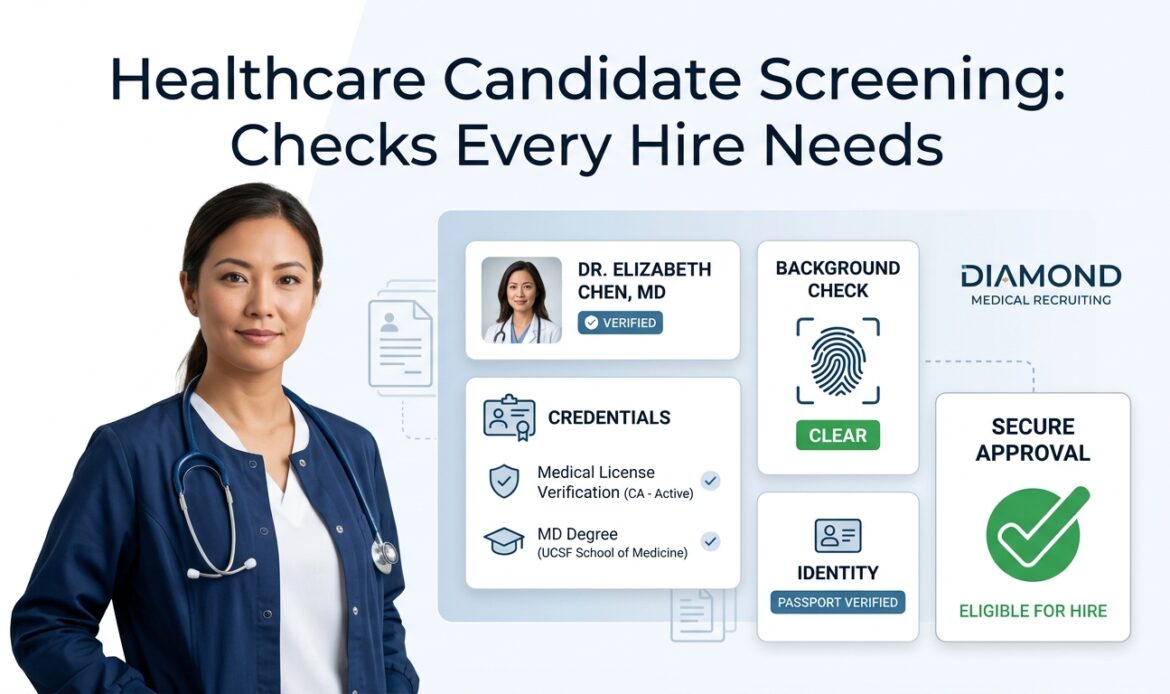
A resume tells you where a clinician says they have worked. It does not tell you whether their license is active in the state where they will practice, whether a federal program has barred them from billing, or whether a strong interviewer will actually thrive in your clinic. Closing that gap is the whole purpose of healthcare candidate screening, and few hiring tasks protect patients, revenue, and compliance all at once the way this one does.
This guide walks through what a complete healthcare candidate screening process includes, which checks are mandatory and which are good practice, the legal guardrails that apply, and how to run every step without stretching a vacancy by weeks. It is written for employers, but clinicians will find a section on what to expect from their side of the process too.
What Does Screening a Clinical Candidate Involve?
Healthcare candidate screening is the structured process of verifying a clinician’s identity, licensure, credentials, work history, and legal eligibility to practice, and then evaluating whether the person fits the role. It happens before an offer is finalized and, for some checks, continues after the hire.
In practice it has four layers:
- Identity and eligibility checks: confirming the person is who they claim to be and can legally work.
- Credential and licensure verification: confirming licenses, certifications, and training are real, current, and unrestricted.
- Risk and history checks: federal exclusion lists, criminal and abuse registries, sanctions, and malpractice history.
- Fit and aptitude evaluation: clinical interviewing, references, and structured assessments.
Skipping any layer leaves a blind spot. A candidate can have a spotless license and still be excluded from federal programs, or pass every check and still be a poor match for a high-volume urgent care schedule.
Why the Stakes Are Higher in Healthcare
Most industries treat screening as risk management. In healthcare it is also a patient-safety and billing issue.
Patient safety. A clinician with an undisclosed disciplinary action or a restricted license can put patients at risk before anyone notices.
Federal program exposure. The HHS Office of Inspector General (OIG) maintains the List of Excluded Individuals and Entities. According to the OIG, excluded individuals cannot receive payment from federal health care programs for items or services they furnish, order, or prescribe, and employers that hire someone on the list may face civil monetary penalties. For a clinic that bills Medicare or Medicaid, that is a direct financial risk.
The cost of a bad hire. When a placement fails, the organization restarts the search while the seat sits empty, a cost we break down in our article on the true cost of a vacant physician position. Careful healthcare candidate screening is cheaper than repeating a search.
The Core Checks, One by One
Each check below is one component of healthcare candidate screening, and none of them substitutes for the others.
Identity and Social Security validation
The first check confirms that the name, Social Security number, and address history actually belong together. A trace of address history also surfaces other names and jurisdictions the person has lived in, which tells you where else to look for licenses and records.
Name variations
Clinicians change names through marriage and other life events, and records are often filed under a former name. A search run only under the current name can miss a disciplinary action or court record entirely. Any serious healthcare candidate screening process searches known name variations.
License verification and sanctions history
The license is the foundation of everything else. Verify that it is active, unrestricted, and issued in the state where the person will practice, or that a compact or multistate privilege applies. Check for past or pending disciplinary actions.
Free public tools, including the Federation of State Medical Boards’ DocInfo physician lookup, are a useful starting point for physicians. But the state board that issued the license remains the authoritative source, and a screenshot of a lookup is not the same as verifying with the issuing source. Candidates who hold licenses in several states need each one checked individually. Treat license verification as the gate that the rest of healthcare candidate screening depends on: if the license fails, nothing else matters.
Federal exclusion screening (OIG LEIE)
An OIG exclusion check compares the candidate against the federal exclusion list. The OIG’s guidance is that health care entities should check routinely, covering both new hires and current employees, to avoid penalty exposure. That last point matters: a clean result on the day of hire does not stay clean forever, so one-time checks are not enough.
Criminal history, sex offender, and state abuse registries
People move, and a record in one state will not appear in another state’s search. That is why screening should be multi-jurisdictional, covering every location in the person’s address history. Sex offender registry and state abuse registry checks matter especially for roles involving children, older adults, or vulnerable patients.
How you use the results is just as important as running the search. We cover the legal rules below.
Malpractice history and the NPDB
The National Practitioner Data Bank (NPDB) is a confidential clearinghouse created by Congress to improve health care quality and reduce fraud and abuse. According to the NPDB’s guidebook, hospitals are the only health care entities required by federal law to query it, and they must do so when a practitioner applies for privileges, including temporary privileges, and every two years for practitioners already on staff. Other health care entities may query when hiring or affiliating with practitioners.
The guidebook does not name staffing agencies among eligible queriers, so employers should plan to run this query through their own credentialing office rather than expect a recruiter to deliver it. Even when a recruiter cannot run the query, healthcare candidate screening should flag any malpractice or privileging history the candidate discloses, so the employer can follow up early. Clinicians can also run a self-query on their own record, which we cover in the candidate section below.
Employment history, references, and certifications
Verify employment dates, reasons for leaving, and gaps. Confirm board certification where the role requires it. For prescribers, confirm DEA registration status. Reference calls should go beyond confirming dates: ask about clinical judgment, reliability, and how the person handled a difficult patient or a heavy schedule.
Beyond Compliance: Assessing Fit and Aptitude
A candidate can clear every compliance check and still be the wrong hire. Anyone who has staffed an urgent care or a busy primary care practice knows that schedule tolerance, communication style, and pace matter as much as credentials. This is where the second half of healthcare candidate screening comes in.
Structured assessments
Pre-employment assessments add objective data to an interview. Diamond Medical Recruiting uses an assessment called the Achiever, which combines mental and personality measures in a single instrument. It measures aptitudes and ten personality traits and uses stanine scoring to compare an individual’s results against a benchmark and a normal distribution. Clients receive the Achiever report alongside the resume and credentials before they hire.
A fair caution applies to any assessment: it should inform a decision, not make it. Tests used in hiring should be job-related, applied consistently, and weighed alongside interviews, references, and verified experience.
Clinical interviewing
Resumes cannot show how a clinician reasons. At Diamond Medical Recruiting, most senior healthcare recruiters are graduates of medical schools, which lets them ask clinical questions before a candidate goes to the final interview with the client’s medical director. A candidate who cannot discuss their own cases and protocols is screened out before they use up a physician leader’s time.
Legal Guardrails Every Employer Should Know
Healthcare candidate screening is regulated. The points below are a summary, not legal advice; have counsel review your process.
The Fair Credit Reporting Act (FCRA)
When a background screening company prepares a report, the FTC’s guidance for employers describes four steps:
- Give the applicant a standalone written disclosure that a report may be used for employment decisions.
- Obtain the applicant’s written authorization.
- Before any adverse action, give the person a copy of the report and a summary of their rights, so they can respond.
- After an adverse action, send notice that identifies the reporting company and explains the person’s right to dispute the report.
That FTC publication dates to 2014, so confirm current requirements with counsel before you build or update a process around it.
Criminal records and the EEOC
The EEOC’s guidance distinguishes arrests from convictions. An arrest alone does not establish that someone committed a crime, while a conviction is usually stronger evidence. The guidance warns that blanket bans on anyone with a record can create disparate-impact risk under Title VII, and it points to a targeted screen with an individualized assessment as a safer approach. That assessment weighs the nature and gravity of the offense, the time that has passed, and the nature of the job, and gives the person a chance to explain.
For healthcare employers this means a conviction involving patient abuse or fraud may reasonably end a candidacy for a patient-facing role, while an old, unrelated offense deserves individual review rather than automatic rejection.
State and local rules
Many states and localities add their own limits on when and how employers may ask about criminal history, and they vary widely. If you hire in more than one state, check each.
Employer vs. Recruiter: Who Does What?
Responsibilities for healthcare candidate screening are shared, and misunderstandings here cause avoidable delays. The table shows a typical division; confirm the details in your agreement.
| Check | Typically completed before candidate submission | Typically completed by the employer |
|---|---|---|
| Identity and Social Security validation | Recruiter’s background check | Re-verified at onboarding |
| License and sanctions history | Recruiter’s pre-screen | Primary source verification by credentialing office |
| Federal exclusion (OIG) check | Recruiter’s pre-screen | Ongoing monitoring of staff |
| Criminal, sex offender, and abuse registries | Recruiter’s background check | Employer policy review and decisions |
| NPDB query | Not typically available to recruiters | Credentialing office or hospital |
| Payer enrollment and privileging | Not applicable | Employer |
| Aptitude assessment and clinical interview | Recruiter | Final interview with the medical director |
Diamond Medical Recruiting describes its own background check as covering name variations, a multijurisdictional medical license database and sanctions history, multijurisdictional criminal history, sex offender, OIG, and state abuse registries, and Social Security validation with a trace to the current residential address. Employers still own the final credentialing decision, and that division is sensible: the recruiter filters early, and the employer verifies at the source.
A Practical Screening Timeline
Healthcare candidate screening does not have to slow a search. The order of operations does most of the work.
- Define requirements first. Specialty, state, certifications, schedule, and any prescribing or supervision requirements.
- Pre-screen before submission. License status, sanctions, and exclusion checks should happen before a candidate reaches your desk, so you spend interview time only on people who can actually be hired.
- Interview with a clinical lens. Combine clinical questions with assessment results.
- Run the formal background report after consent. Follow the FCRA steps above.
- Start credentialing in parallel with the offer. Do not wait for a signed offer to begin primary source verification, payer enrollment, and privileging.
For a deeper look at why parallel steps matter, see our guide to physician recruitment best practices and our walkthrough on how to hire physicians effectively. Diamond Medical Recruiting states that every profile it delivers has already been screened, background-checked, and assessed, with a guaranteed first candidate within 5 to 10 business days, which is how pre-screening compresses the front end of a search.
Common Screening Mistakes
- Trusting self-reported information. Every license and certification should be verified at the source.
- Checking only the current state. Address history and multi-state licenses mean records can live elsewhere.
- Running checks once and never again. Federal exclusion status can change after hire, so monitoring should continue.
- Using blanket criminal exclusions. They invite legal risk and can screen out qualified people. Use a targeted screen with individual review.
- Skipping name variations. A missed former name can hide a relevant record.
- Starting credentialing after the offer. This is the most common reason a signed candidate cannot start for weeks.
- Poor documentation. If you cannot show what you checked and when, you cannot defend the decision later.
Avoiding these mistakes is cheaper than any fix, and it improves retention, a topic we cover in reducing healthcare turnover.
The Candidate’s View: What Clinicians Should Expect
Clinicians sometimes read thorough healthcare candidate screening as distrust. It is better understood as standard practice that protects them as well as patients. To move through it smoothly:
- Keep license numbers, board certification details, and DEA information ready.
- Be ready to explain any gaps in employment or past disciplinary matters honestly and early. Surprises found by a background check hurt far more than disclosures made up front.
- Consider running a self-query. The NPDB lets health care professionals use a personal account to check for reports about themselves, so you will know what an employer might see.
- Ask what the process includes and how long it usually takes.
Clinicians who want to be matched with vetted employers can start on our Job Seekers page, and candid conversations early in the process help us set realistic expectations on both sides.
Questions to Ask a Recruiting Partner About Their Process
If you outsource part of your hiring, the quality of a partner’s healthcare candidate screening should be a deciding factor. Ask:
- Which checks happen before you submit a candidate, and which are left to us?
- Do you search name variations and every state in the candidate’s history?
- Do you screen against federal exclusion lists, and how often?
- Do you use assessments, and how are results used in your recommendations?
- Who conducts clinical interviews, and what are their credentials?
- What happens if a placement fails after the hire?
For a broader evaluation framework, read our buyer’s guide to choosing a healthcare staffing agency.
Putting It Together
Good healthcare candidate screening is not one check; it is a sequence: verify identity, confirm the license at its source, check federal exclusion and registries, understand malpractice history, assess fit, and document everything within the legal rules. Done in the right order and in parallel with credentialing, it protects patients and billing without adding weeks to a search.
If you are hiring and want vetted candidates delivered on a timeline that respects your schedule, contact Diamond Medical Recruiting or review how we work on our employer page. Our pay-only-when-you-hire model and written 90-day guarantee mean you can evaluate our screening on real candidates before committing to a fee.
Frequently Asked Questions
What does a healthcare background check include? It typically covers identity and Social Security validation, name variations, license verification and sanctions history, federal exclusion screening, criminal history across relevant jurisdictions, and sex offender and state abuse registries. Exact contents vary by employer and role.
How often should employers check the OIG exclusion list? The OIG advises health care entities to check routinely, covering both new hires and current employees. The OIG page does not set a specific interval, so confirm your own schedule with compliance counsel.
Can a recruiter query the NPDB? The NPDB’s published guidance does not list staffing agencies among eligible queriers. Hospitals are required to query, and other health care entities may query when hiring or affiliating with practitioners, so employers should plan to run it through their own credentialing office.
Is a criminal record an automatic disqualifier for clinical roles? Not automatically. The EEOC recommends a targeted screen with individualized assessment rather than blanket bans, weighing the offense, the time elapsed, and the nature of the job. Some offenses, such as patient abuse or healthcare fraud, are clearly relevant to patient-facing roles.
How long does credentialing take after a candidate accepts an offer? It varies by facility, payer, and state, and can take several weeks. Starting primary source verification and payer enrollment in parallel with the offer process is the most reliable way to shorten the gap.
What is the difference between a background check and credentialing? A background check looks at identity, criminal history, registries, and licensing history, usually early in the process. Credentialing is the employer’s formal verification of qualifications directly from source, plus payer enrollment and privileging, and it is typically completed before the clinician starts seeing patients.
Do pre-employment assessments replace interviews? No. Assessments add objective data, but they should be job-related, used consistently, and weighed alongside interviews, references, and verified experience.